
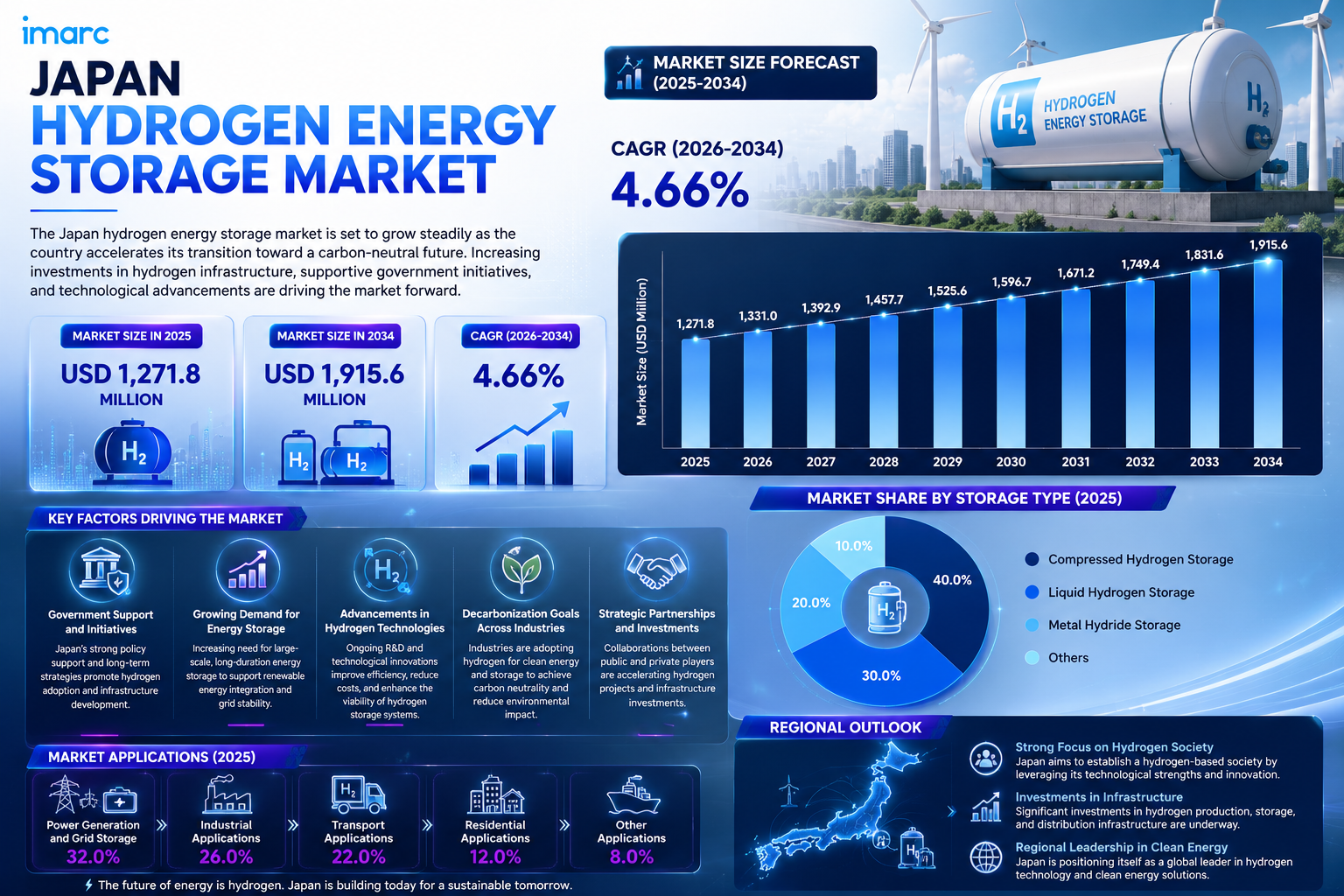
Japan Hydrogen Energy Storage Market Report 2026-2034
Market Size in 2025: USD 1,271.8 Million
Market Forecast in 2034: USD 1,915.6 Million
Market Growth Rate 2026-2034: 4.66% CAGR
According to the latest report by IMARC Group, the Japan hydrogen energy storage market size reached USD 1,271.8 Million in 2025. Looking forward, the market is projected to reach USD 1,915.6 Million by 2034, exhibiting a CAGR of 4.66% during 2026-2034. The market is being propelled by strong government policies promoting carbon neutrality, increased investment in renewable energy integration, and energy security concerns. The country is advancing pilot projects in green hydrogen production and storage, particularly through collaborations with the private sector and regional energy suppliers. Additionally, the growing focus on smart grid development and mobility-based hydrogen applications is an important factor expanding the Japan hydrogen energy storage market share.
Evaluate Market Opportunity with the Business Sample Report: https://www.imarcgroup.com/japan-hydrogen-energy-storage-market/requestsample
Japan Hydrogen Energy Storage Market Overview
Japan's hydrogen energy storage sector sits at the heart of the country's long-term clean energy strategy. As a nation with limited domestic fossil fuel resources and an ambitious carbon neutrality target for 2050, Japan has placed hydrogen storage at the center of its energy transition roadmap. Hydrogen energy storage enables the country to capture surplus renewable energy, balance grid fluctuations, and build a reliable, low-carbon energy carrier for power generation, transportation, and industrial applications.
The Japan hydrogen energy storage market spans a broad range of storage technologies including high-pressure gas compression, cryogenic liquid hydrogen systems, and solid-state material-based solutions such as metal hydrides, ammonia carriers, and liquid organic hydrogen carriers (LOHCs). These formats are enabling Japan to design hydrogen infrastructure that is both versatile and scalable across decentralized and centralized energy applications. Japan's updated Basic Hydrogen Strategy aims to mobilize approximately USD 96.77 Billion in public and private investment over 15 years, targeting a sixfold increase in hydrogen utilization by 2040.
Japan Hydrogen Energy Storage Market Trends & Drivers
The first is the institutional policy architecture that underpins the market. Japan's Strategic Roadmap for Hydrogen and Fuel Cells, revised in 2023, outlines clear targets for expanding hydrogen across industry, transport, and power generation. The Ministry of Economy, Trade and Industry has established frameworks to commercialize hydrogen storage by promoting advanced materials research and supporting pilot demonstrations of high-capacity systems. Government-backed initiatives include subsidies for storage technologies, public-private partnerships to deploy hydrogen storage systems, and regulatory support for grid integration. These policy mechanisms provide long-term investment certainty and accelerate technology maturation across decentralized and centralized storage segments within Japan's hydrogen energy storage market.
The second defining trend is the rapid pace of technological advancement in storage systems. Japanese stakeholders are actively developing high-pressure gas tanks, cryogenic liquid hydrogen storage systems, and solid-state solutions such as metal hydrides and chemical carriers. Emerging hydrogen storage formats including ammonia and liquid organic hydrogen carriers allow for stable, dense, and transportable hydrogen storage with minimal pressure requirements. On March 28, 2025, Tsuneishi Shipbuilding Co., Ltd. unveiled Japan's first hydrogen-powered tugboat at its Fukuyama facility in Hiroshima, integrating a hydrogen dual-fuel internal combustion engine and a high-pressure hydrogen gas storage system, representing a milestone in maritime decarbonization. Efforts in materials engineering and smart monitoring are further enhancing storage safety, thermal stability, and scalability.
Japan Hydrogen Energy Storage Market Growth Drivers
- National Carbon Neutrality Policy and Basic Hydrogen Strategy: Japan's institutional commitment to achieving carbon neutrality by 2050, supported by the Basic Hydrogen Strategy and METI's technology commercialization frameworks, creates a stable, long-term demand environment for hydrogen energy storage solutions across utilities, transport, and industrial sectors.
- Renewable Energy Integration and Grid Balancing Demand: The expansion of solar and wind energy capacity across Japan is creating a growing need for large-scale hydrogen storage to absorb surplus generation, balance grid loads, and ensure stable baseload power supply, directly expanding the addressable market for hydrogen energy storage systems.
- International Hydrogen Supply Chain Development: Japan's recognition that domestic renewable capacity alone cannot meet long-term hydrogen demand is driving partnerships with Australia, the Middle East, and Southeast Asia for green and blue hydrogen imports, indirectly requiring domestic storage and distribution infrastructure investment to support consistent supply.
- Smart Grid and Mobility Applications: The convergence of smart grid development and hydrogen-powered mobility solutions including FCEVs, commercial trucks, and maritime vessels is creating new multi-directional demand for scalable hydrogen energy storage infrastructure across Japan's urban and industrial regions.
Key Growth Opportunities in the Japan Hydrogen Energy Storage Market
- Hydrogen Hub Infrastructure Program: Japan's ¥5.7 Billion national hydrogen hubs tender, aimed at subsidizing shared pipeline and storage facilities across eight to ten regional hubs, represents a significant near-term project opportunity for hydrogen storage technology providers and system integrators.
- Liquid Hydrogen and LOHC Technology Commercialization: The transition from pilot to commercial-scale liquid hydrogen and LOHC storage and transport systems presents high-value investment opportunities for companies that can deliver certified, safe, and cost-efficient solutions aligned with Japan's import supply chain requirements.
- Maritime and Aviation Hydrogen Storage Applications: The expansion of hydrogen storage into maritime vessels and aviation ground infrastructure, exemplified by Tsuneishi's hydrogen tugboat project and Airbus-Toshiba's aircraft motor collaboration, is creating entirely new application segments for advanced hydrogen storage systems.
Japan Hydrogen Energy Storage Market Segmentation
Storage Form Insights:
- Solid
- Liquid
- Gas
The report has provided a detailed breakup and analysis of the market based on the storage form. This includes solid, liquid, and gas.
Technology Insights:
- Compression
- Liquefaction
- Material Based
A detailed breakup and analysis of the market based on the technology have also been provided in the report. This includes compression, liquefaction, and material based.
Application Insights:
- Stationary Power
- Transportation
The report has provided a detailed breakup and analysis of the market based on the application. This includes stationary power and transportation.
End User Insights:
- Utilities
- Industrial
- Commercial
A detailed breakup and analysis of the market based on the end user have also been provided in the report. This includes utilities, industrial, and commercial.
Regional Insights:
- Kanto Region
- Kansai/Kinki Region
- Central/Chubu Region
- Kyushu-Okinawa Region
- Tohoku Region
- Chugoku Region
- Hokkaido Region
- Shikoku Region
Competitive Landscape
The market research report offers an in-depth analysis of the competitive landscape, covering market structure, key player positioning, top winning strategies, a competitive dashboard, and a company evaluation quadrant. Additionally, detailed profiles of all major companies are included.
- Iwatani Corporation
- ENEOS Holdings, Inc.
- Toyota Motor Corporation
- Mitsubishi Power, Ltd.
- Kawasaki Heavy Industries, Ltd.
Key Strategies Adopted by Market Players
- Large-scale liquid hydrogen production and domestic distribution network expansion
- International supply chain partnerships for green and blue hydrogen imports
- Technology investment in metal hydride, LOHC, and ammonia carrier storage formats
- Public-private collaboration on hydrogen hub infrastructure projects
- Integration of hydrogen storage with smart grid and renewable energy systems
Recent News and Developments
- March 2025: Japan initiated its ¥5.7 Billion tender under the national hydrogen hubs program, aiming to subsidize shared infrastructure such as pipelines and storage facilities to support multiple companies across eight to ten planned hydrogen and ammonia hubs.
- March 2025: Tsuneishi Shipbuilding Co., Ltd. unveiled Japan's first hydrogen-powered tugboat at its Fukuyama facility in Hiroshima, integrating a hydrogen dual-fuel internal combustion engine and a high-pressure hydrogen gas storage system, marking a milestone in Japan's maritime decarbonization and hydrogen energy storage advancement.
Investment Opportunities in the Japan Hydrogen Energy Storage Market
Japan's hydrogen energy storage market presents well-structured investment opportunities across the forecast period. Hydrogen hub infrastructure including shared pipelines, storage terminals, and liquefaction facilities represents the most capital-intensive and strategically significant investment category, backed by direct government subsidy support. Material-based storage technology development, including metal hydrides and LOHC systems, offers high-margin intellectual property opportunities for advanced materials companies. Hydrogen refueling station networks for FCEVs and commercial vehicles represent scalable, recurring revenue infrastructure investments. International investors can access the Japan hydrogen energy storage market through joint ventures, technology licensing, and supply chain partnership structures with established Japanese industrial groups.
Future Outlook
The Japan hydrogen energy storage market is on a measured but structurally sound expansion trajectory through 2034, with a projected CAGR of 4.66% reflecting the current stage of infrastructure buildout and technology commercialization. The gradual reduction in green hydrogen production costs, combined with the progressive rollout of hydrogen distribution networks and FCEV infrastructure, will support sustained volume growth. Japan's international supply chain partnerships will contribute to supply-side stability, ensuring domestic demand can be met as local production scales. By 2034, the market is expected to evolve into a mature, multi-modal hydrogen storage economy with material-based and liquid hydrogen systems occupying an expanding share of the overall mix.
Why Buy This Report?
- Comprehensive market intelligence and forecast analysis for 2026-2034
- Detailed segmentation across storage form, technology, application, and end user
- Regional insights covering all major Japanese prefectural markets
- Competitive landscape profiling and strategy analysis
- Key trends, investment opportunities, and growth drivers
- Customized analyst support available on request
Note: If you require specific details, data, or insights that are not currently included in the scope of this report, we are happy to accommodate your request. As part of our customization service, we will gather and provide the additional information you need, tailored to your specific requirements. Please let us know your exact needs, and we will ensure the report is updated accordingly to meet your expectations.
About Us:
IMARC Group is a global management consulting firm that helps the world's most ambitious changemakers to create a lasting impact. The company provides a comprehensive suite of market entry and expansion services. IMARC offerings include thorough market assessment, feasibility studies, company incorporation assistance, factory setup support, regulatory approvals and licensing navigation, branding, marketing and sales strategies, competitive landscape and benchmarking analyses, pricing and cost research, and procurement research.
Contact Us:
Street: 563-13 Kamien
Area: Iwata
Country: Tokyo, Japan
Postal Code: 4380111
Email: [email protected]